When an owner begins planning a vessel transfer across Europe, initial attention usually centers on highway distances or ferry timetables. Experienced marine hauliers, however, work in reverse: the itinerary is dictated by the boat's true geometric envelope, load points, and the physical constraints of harbor access lanes. Until every fixed dimension is confirmed, no road route can be reliably authorized.
1. Accurate Physical Dimensions: Beyond the Sales Brochure
One of the most frequent sources of transit delays is reliance on manufacturer specification sheets. Brochure figures routinely cite nominal hull measurements rather than total transport bulk. Projections such as pulpit anchors, bowsprits, boarding platforms, davits, and outdrive legs directly impact overall length and highway permit thresholds.
Before submitting permit applications or dispatching trailers, verify these critical dimensions on hardstanding:
- Transport Length Overall (LOA): From the outermost tip of the bow roller or anchor to the rearmost edge of the swim platform, rudder post, or stern drive cowlings.
- Maximum Transport Beam: The absolute widest section of the vessel, including rub rails, fender baskets, and spray strakes. In several European countries, a discrepancy of just 5 cm can elevate a transport into a higher abnormal load tier requiring private escort pilot vehicles.
- Loaded Air Draft: The height from the lowest point of the keel or skeg to the highest non-removable superstructure fitting, plus the trailer bed ride height (typically 30 cm to 70 cm on specialized low-bed marine trailers).
- Actual Weight vs. Dry Displacement: Published dry weights exclude fuel, freshwater, auxiliary outboards, anchors, chains, safety gear, and personal cruising equipment. Practical transit displacement is routinely 15% to 25% higher than brochure specifications.
2. Center of Gravity & Keel Cradle Alignment
Vessels are built to distribute weight evenly across water. On a road transporter, that entire mass is transferred through a small number of contact points. Proper cradle selection ensures that concentrated loads align with structural bulkheads and internal longitudinal stringers rather than unsupported hull laminate.
Deep-draft sailing yachts typically require deep drop-frame well trailers so the fin keel sits within a central trough, keeping the vertical center of gravity low and preserving motorway bridge clearances. Planing powercraft, by contrast, need continuous padded bunks fitted precisely to deadrise angles to prevent gelcoat stress cracking under highway vibration.
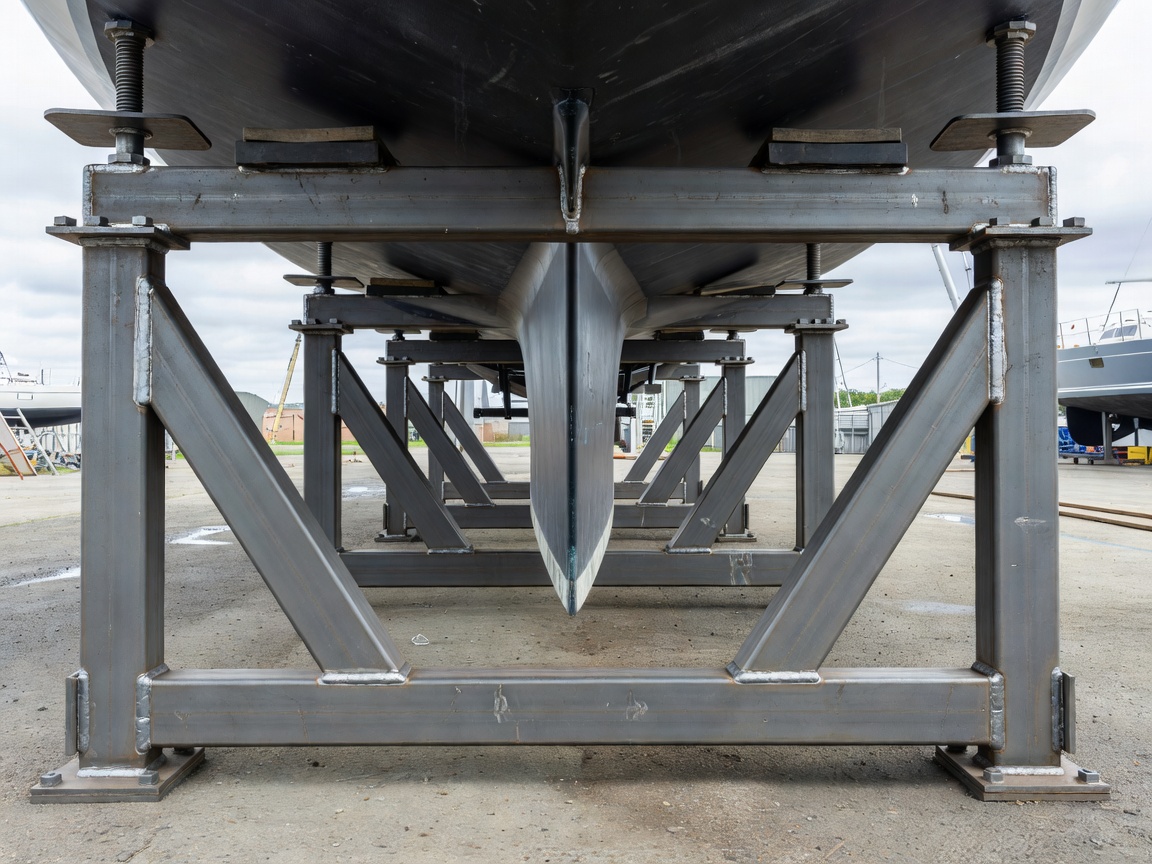
Cradle Screw-Pad Placement
Screw-pad jacks must bear directly beneath primary bulkheads or engine bearers. They should never be set against unsupported hull skins or placed over hull transducers and speed-log fittings.
3. Marina First- and Last-Mile Access
A transit may proceed smoothly along multi-lane European autoroutes only to stall within three hundred meters of the destination marina. Historic port towns and coastal fishing harbors often present steep gradients, low stone arches, tight roundabouts, and overhead utility lines.
A complete pre-haul survey must verify:
- Turning radius for articulated tractor-trailer units reaching up to 22 meters overall length.
- Overhead electrical cabling, telephone lines, and gated boom barriers at marina entries.
- Travel-lift apron ground-bearing capacity and hook clearance height.
- Slipway gradients and low-water depth during tidal launch windows.
Planning Checklist: Key Data Points
| Logistics Factor | Verification Metric | Common Risk Factor |
|---|---|---|
| Total Air Draft | Keel tip to highest fixed arch + trailer height | Overlooking radar domes or flybridge windscreens |
| Displacement | Crane load cell reading on haul-out | Relying on dry factory catalogue weight |
| Beam Width | Extreme outer edge including rub rails | Triggering unexpected police escort requirements |
| Harbor Hoist Window | Safe working load (SWL) and sling spread | Crane capacity insufficient for loaded boat mass |
| Transit Paperwork | Registration, bill of sale, and VAT status | Customs impoundment during non-EU frontier crossings |
Pro-Tip on Hoist Load Cells
During haul-out, ask the dockmaster or crane operator for the digital load cell reading while the hull is clear of the water. Photographing this readout provides your haulier with an exact mass figure, preventing axle overloading penalties and ensuring correct permit declarations across transit territories.